


More Australian businesses are using AI than ever before — and it’s not just large enterprises anymore. Small businesses, mid-size firms, and fast-growing startups are all adopting AI to stay competitive.
But here’s the real challenge:
Knowing AI is changing things is easy — knowing what to do about it is not.
A recent study by IBM found that 77% of businesses globally say AI adoption is moving faster than their teams can keep up with. In Australia, this gap is even more visible. Many companies are still relying on outdated systems, while competitors are already using AI to save time, reduce costs, and improve customer experience.
In this blog, we break down the five biggest AI trends shaping Australian businesses in 2026 — in simple terms, with clear examples, and practical insights you can act on.
This trend is about more businesses — large and small — starting to use AI tools in their day-to-day work.
Not long ago, AI was something only big corporations with large IT budgets could afford. That is no longer the case. Tools like ChatGPT, Microsoft Copilot, and Google Gemini have made it possible for even a 10-person business to use AI for emails, customer support, content, and data sorting.
65% of Australian SMBs plan to increase AI tool usage in 2026 ( Source: Gartner 2025 Technology Trends Report for Asia-Pacific )
What this means in real terms: a small accounting firm can now use AI to sort invoices. A retail business can use it to predict which products will sell more next month. A law office can use it to review documents faster.
Several things are pushing Australian businesses toward faster AI use.
Hybrid cloud means using a mix of private servers (that a business owns) and public cloud platforms (like AWS or Microsoft Azure). This combination is now the most popular setup for Australian businesses.
Most businesses do not want to put everything on a public cloud, but they also do not want to manage everything themselves. Hybrid cloud gives them the best of both worlds — security for sensitive data and flexibility for everything else.
The Gartner Cloud Strategy report shows that hybrid cloud setups have grown by 34% in the Asia-Pacific region over the last two years. Australian businesses in finance, health, and education are leading this shift because they deal with private data that needs careful handling.
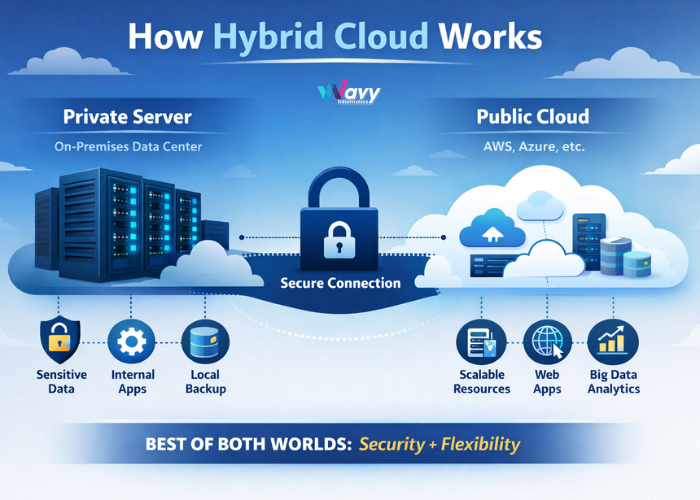
Here are the key reasons businesses prefer this setup over going fully public or fully private.
If you are thinking about where your business fits in this picture, our cloud readiness guide for Australian businesses is a good starting point.
Get a free 30-minute IT assessment tailored to your business size and goals.
AI is now being used to detect online threats before they cause damage — and this is changing how Australian businesses protect themselves.
Cyber attacks on Australian businesses went up by 23% in the last year, according to the Australian Cyber Security Centre (ACSC) 2025 Annual Report. Small and mid-size businesses are now the most targeted because attackers know they often have weaker protection than big companies.
The good news is that AI-based security tools are now stepping in. These tools watch your systems around the clock, spot unusual activity, and send alerts before anything serious happens. They learn from patterns over time, which means they get better the longer they are used.
These are not complicated tools — think of them as a digital security guard that never sleeps.
Automation has been around for years, but AI has made it far more powerful — and far more accessible to businesses that are not in the tech industry.
Old automation handled one task at a time. AI automation handles whole processes. A business can now set up a system that reads a customer email, understands what the customer needs, pulls up their account details, drafts a reply, and sends it — all without a person being involved at every step.
40% reduction in time spent on admin tasks reported by Australian businesses using AI automation ( Source: Deloitte Australia Digital Economy Report, 2025)
These are the areas where Australian businesses are saving the most time right now.
This is also where IT services for Australian businesses are stepping up — helping companies choose, install, and manage these automation tools properly. Visit our automation solutions page to see how this works in practice.
Australian businesses are sitting on huge amounts of data — but most of them are not using it well. That is starting to change.
Every customer interaction, sale, website visit, and support ticket creates data. For years, that data sat in different systems and was rarely looked at. Now, AI tools can pull all of that together, clean it up, and help businesses make better decisions based on what the data shows.
This is not just for big companies. A café chain with 12 locations can use AI to see which items sell best at which times, then adjust their ordering and staffing. A law firm can track which client types bring in the most work. A property manager can spot maintenance patterns before they become expensive problems.
The big change in 2026 is not collecting more data — it is finally doing something useful with it.
You do not need to act on all five trends at once — but knowing where to start puts you ahead of most businesses.
AI is not going to replace the way you run your business overnight. But the businesses that start getting comfortable with these changes now will find it much easier to grow and stay secure over the next few years. The ones that wait may find they are spending more time and money catching up later.
The most practical first step for most businesses is a simple IT review — looking at what systems you are using, what data you have, and where the biggest gaps are. From there, it becomes much easier to see which of these five trends applies to you most.
IT services for Australian businesses are not just about fixing problems when they happen. In 2026, they are about helping businesses plan ahead, stay protected, and use the right technology to grow without burning out their teams.
Hybrid cloud is a setup that combines private servers (on-site or dedicated) with public cloud services like Amazon Web Services or Microsoft Azure. It allows businesses to keep sensitive data secure while using the cloud for flexibility and scalability.
Australian businesses are adopting AI to reduce costs, save time, and improve customer experience. Tools like ChatGPT and Google Gemini make AI accessible even for small businesses.
No, many AI tools are now affordable and subscription-based. Small businesses can start with low-cost tools and scale as they see results.
AI improves cybersecurity by detecting unusual activity, blocking threats automatically, and preventing phishing attacks. Organizations like the Australian Cyber Security Centre recommend using advanced monitoring tools for better protection.
AI can automate tasks like customer support, invoice processing, reporting, and employee onboarding. This helps businesses save time and reduce manual errors.
The best way to start is by identifying one repetitive task—such as email handling or reporting—and testing an AI tool. From there, businesses can expand gradually based on results.
We work with Australian businesses every day to simplify IT — no jargon, no pressure, just practical advice tailored to your goals.