
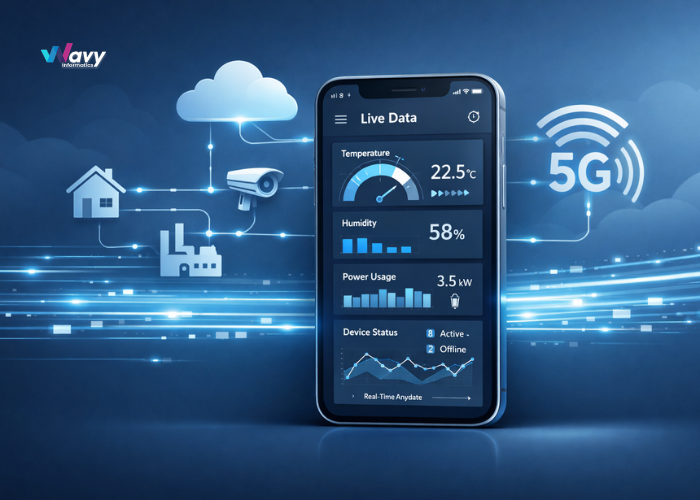


Real-Time App Development focuses on delivering seamless, low-latency digital experiences. From gaming and video calls to healthcare and e-commerce, modern applications must process and respond to data instantly.
Edge AI and 5G are transforming how these applications are built. Edge AI enables real-time data processing closer to the user, while 5G provides ultra-fast connectivity with minimal latency. Together, they power a new generation of intelligent, responsive, and scalable applications.
This guide explains how Edge AI and 5G work together, the tools required, and the step-by-step process to build high-performance real-time apps.
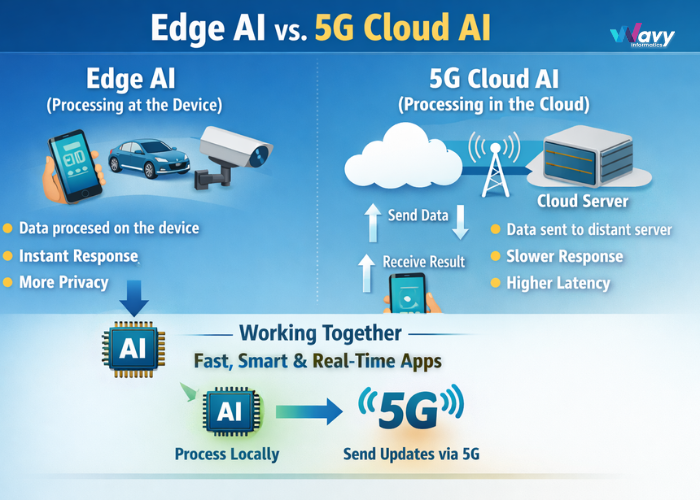
Edge AI brings smart power to the edges of networks, right where users are. Devices like phones or cars run AI tasks without sending everything to far-away servers. This cuts wait time and keeps things private.
In real time mobile app development, Edge AI spots patterns fast. A camera app knows your face in seconds. Apps stay quick even with spotty internet. Developers place AI models on user devices. These models learn from local data. 5G helps by sending only key updates back to the main systems.
Here is what Edge AI does inside an app:
5G is the fifth generation of wireless internet. It is much faster than 4G, and more importantly, it has something called low latency, which means there is almost no gap between when you send information and when it arrives. For apps, this is a big deal.
Here is how 5G supports next-gen app development:
Start with a clear plan. Pick what the app does and who uses it. Draw simple screens on paper first.
Real time mobile app development needs tools that match Edge AI and 5G. Use kits like TensorFlow Lite for AI on phones. Test on 5G SIMs early. Code the core first – login, main screen, data share.
Here is how to go step by step:
Run tests on many phones. Fix bugs before launch. Users love apps that work everywhere.
Tools make work easy. Developers pick ones that fit AI-powered applications. Open-source options save time and money.
Frameworks like React Native are built for iPhone and Android at the same time. Add Edge AI plugins for smart features. 5G test beds check network speed. Track app use with free analytics.
Mix tools for high-performance applications. Start with free versions. Scale up as users grow.
Apps face hurdles like battery drain or lost signals. Teams spot these early.
Smart app solutions handle weak spots. Edge AI saves power by working locally. 5G drops happen – code backups for 4G. Test in real spots like buses or hills. Users stay connected.
Watch for these:
Fix one by one. User feedback helps most.
When Edge AI and 5G are combined in app development, the results go far beyond what was possible just a few years ago. The app does not just respond fast — it also thinks fast, learns from user behavior, and adjusts on the fly.
Here is what this combination unlocks:
Real-time app development focuses on building applications that process and respond to data instantly. These apps provide immediate updates, enabling features like live chat, online gaming, real-time tracking, and video streaming without noticeable delays.
Edge AI means your app processes data close to the user, like on a phone or device, instead of sending it far away to a server. This makes the app faster and more responsive.
Edge AI improves performance by processing data directly on the user’s device instead of relying on distant cloud servers. This reduces latency, enhances speed, improves data privacy, and allows apps to function even with limited internet connectivity.
5G enables ultra-fast data transfer and extremely low latency, making it ideal for real-time applications. It ensures smooth performance for features like live streaming, augmented reality, and instant data synchronization across devices.
Combining Edge AI and 5G allows apps to process data locally while also sharing it quickly across networks. This results in faster response times, better scalability, improved user experience, and more reliable performance for high-demand applications.
Apps that need fast response work best with this setup, such as:
The starting cost can be higher due to setup and tools. But over time, it can reduce server costs and improve user experience, which gives better returns.
Yes, small businesses can start with basic features. They can test small use cases and then grow step by step without spending too much at once.
Edge AI and 5G are not just ideas on paper. They are already being used in many areas of daily life:
Healthcare — Doctors and nurses use apps to monitor patients’ heart rate, oxygen levels, and more, all in real time. The data goes from the patient’s device to the doctor’s screen without delay.
Retail and Shopping — Stores use smart app solutions to manage stock, track customer flow, and send personalized offers to shoppers while they are still inside the store.
Education — Students can use AI-powered applications that adapt to their learning speed, give instant feedback on answers, and create a more personal learning experience.
Transportation — Ride-hailing and delivery apps use real-time traffic data, AI predictions, and fast network connections to find the best routes and reduce wait times.
Manufacturing — Factories use apps to track machines, predict when a part might break, and alert workers before a problem gets worse.
Before jumping into this type of app development, it is good to know a few important things:
Building apps that use Edge AI and 5G is one of the most exciting areas in technology right now. It gives developers the power to create apps that are fast, smart, and useful in ways that were hard to imagine before. If you want to build something that stands out, works without delay, and gives users a smooth experience, this is the direction to go. Wavy Informatics helps businesses and startups build scalable, AI-powered applications that are built for the future — combining the latest in Edge AI with the speed of 5G to deliver apps that are fast, reliable, and ready to grow.